Trial Court Series No. 1 Published on Aug. 7, 2010
Experience Actually Starts in the Courtroom
I had my first taste of courtroom advocacy, and, man, did I become energized!
Trial work involved cross-examination, closing arguments, and the ability to “argue” in front of a captive audience.
Paul Messing, my advocacy instructor, became my “Guiding Light” when he directed me into becoming a “litigator,” presenting me with the award of “Barrister” for the best advocate in the class at Temple Law School.
That provided me an “in” for an interview with the Philadelphia Defender Association, which had just been named the best in the country.Lawyers are made up of Barristers and Litigators
Lawyers are made up of Barristers and Litigators
There are several different types of lawyers. A barrister refers to an attorney who appears in a courtroom before a judge and sometimes a jury of 12 members of a defendant’s so-called “peers.” Solicitor is the name given to lawyers who write wills, represent clients in a divorce proceeding, or in some other legal and civil matters that take place in a lawyer’s office.
Both terms originated in Great Britain and the best example of what a barrister might look like is in the movie “Witness for The Prosecution” with Charles Laughton wearing a white “bib.”
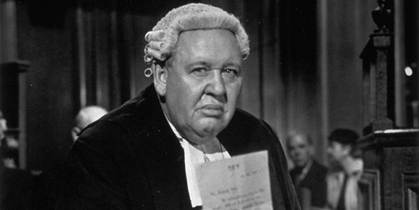
Charles Laughton as a Barrister
Other great presentations of courtroom barristers include James Stewart in the “Anatomy of a Murder,” and Paul Newman in “The Verdict.“
My most favorite job as a young man was serving as a union organizer for The Newspaper Guild of Philadelphia. I had taken a leave of absence from my work as a newspaper reporter for the Pottstown Mercury Newspaper and felt I was spreading the word of hope for so many journalists getting underpaid. That was the main reason for me to go to law school and to continue helping working-class people.
“I took it as a sign from God” is how I explained to Chief Defender Ben Lerner about getting a D in a labor law class. It forced me to look for another legal path to pursue rather than becoming a labor lawyer, which I had enrolled in Temple Law School to pursue
Being Candid on Why I Chose Trial Work
“I turned to criminal law, became interested in trial work, and wanted to do jury trials,” I added during my interview with Lerner. I also noted that I was on the Trial Team at Temple competing with students from other law schools, but lost when my Philadelphia accent did not go over well in the deep South.
Lerner appreciated my candor and, more importantly, he hired me, particularly after I told him how much I wanted to try cases before a jury. I had been inspired by one of his staff members, Paul Messing. (Ben Lerner was eventually named a judge in the Common Pleas Court of Philadelphia.)
And so, I practiced criminal law for the next 20 years, once establishing an informal record of trying 10 jury trials in the span of only nine weeks. Ten jury trials are more than many lawyers try in their lifetimes!
I believe that I was a damn good lawyer who faught hard for all of my clients.
Thank you, Paul Messing!


Beautifully said 🥰
LikeLiked by 1 person
Thak you my good WordPress friend!
LikeLiked by 2 people
Fantastic! What a blessing to have mentors to guide you! And it truly sounds as though you really enjoyed your work!
LikeLike
I am so happy that I can remember persons who have acted as guides in my life. They paved the way for so many paths I have taken, and, on occasion, helped to direct me away from some. I am not worried about the “road not taken</em>” because the roads they helped me to choose seemed to be far* “less traveled by.”*
LikeLiked by 2 people